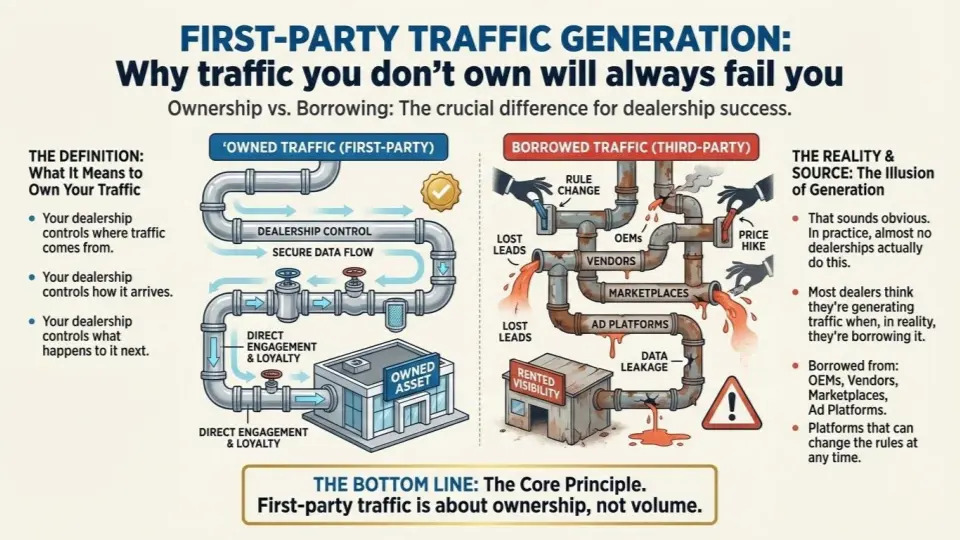
Why traffic you don’t own will always fail you
First-party traffic generation means your dealership controls where traffic comes from, how it arrives, and what happens to it next.
That sounds obvious. In practice, almost no dealerships actually do this.
Most dealers think they’re generating traffic when, in reality, they’re borrowing it from OEMs, vendors, marketplaces, or ad platforms that can change the rules at any time.
First-party traffic is about ownership, not volume.
What First-Party Traffic Actually Means
Common sense definition:
If someone turns something off and your traffic disappears, it was never yours.
First-party traffic means:
- You control the pages that rank
- You control the content that attracts clicks
- You control how visitors move through your site
- You control the data generated by those visits
If any of those are outsourced, shared, or abstracted behind a vendor, ownership is compromised.
Why Borrowed Traffic Is Always Risky
Borrowed traffic feels fine until it doesn’t.
Dealerships borrow traffic through:
- OEM-controlled site structures
- Vendor-owned microsites
- Third-party marketplaces with no leverage
- Paid campaigns that reset every month
The problem isn’t using these channels.
The problem is depending on them.
Borrowed traffic creates dependency.
First-party traffic creates stability.
First-Party Traffic Is Built, Not Bought
You cannot buy first-party traffic.
You build it by:
- Publishing content you own
- Ranking pages you control
- Creating entry points that persist
- Strengthening assets over time
This is why first-party traffic grows slowly at first, then suddenly becomes predictable. Once built, it doesn’t disappear because a contract ends or a budget shifts.
Why Dealership Websites Rarely Generate True First-Party Traffic
Most dealership websites are structurally limited.
They’re often:
- Locked into OEM templates
- Bloated with third-party scripts
- Dependent on vendor workflows
- Not designed to expand content meaningfully
The result is a site that converts traffic but doesn’t generate it.
Generation requires surface area.
Surface area requires structure.
Content Is the Engine of First-Party Traffic
First-party traffic doesn’t come from a homepage.
It comes from:
- Informational pages
- Comparison content
- Location-specific assets
- Service-focused resources
- Long-tail, intent-matched answers
Each page becomes a permanent entry point.
Enough entry points, and traffic becomes resilient.
This is how first-party traffic compounds.
Data Ownership Is the Silent Advantage
When traffic is first-party:
- Analytics are cleaner
- Attribution is clearer
- Optimization is possible
- Decision-making improves
When traffic is borrowed:
- Reporting is abstracted
- Intent is obscured
- Optimization guesses replace insight
First-party traffic doesn’t just bring visitors it brings clarity.
How the Trifecta Platform Solves First-Party Traffic Generation for Dealerships
The Trifecta platform solves first-party traffic generation by expanding ownership beyond a single dealership website. Instead of relying on OEM structures or vendor-controlled assets, the system creates multiple owned entry points through marketplaces, content properties, and AI-indexable environments that the dealership participates in and benefits from directly. These assets generate traffic independently, route visitors intentionally, and preserve data ownership, reducing reliance on any one source. The result is traffic the dealership doesn’t rent it accumulates.
The Bottom Line
First-party traffic generation isn’t about abandoning vendors or platforms.
It’s about not being trapped by them.
Dealerships that own their traffic:
- Weather algorithm changes
- Spend less on ads over time
- See clearer performance signals
- Make better decisions
If traffic can be taken away, it was never yours.
✍️ Signed & Accountable
This article reflects firsthand system design, live dealer data, and operational experience building organic traffic, marketplace demand, and AI-indexed content at scale for automotive dealers.