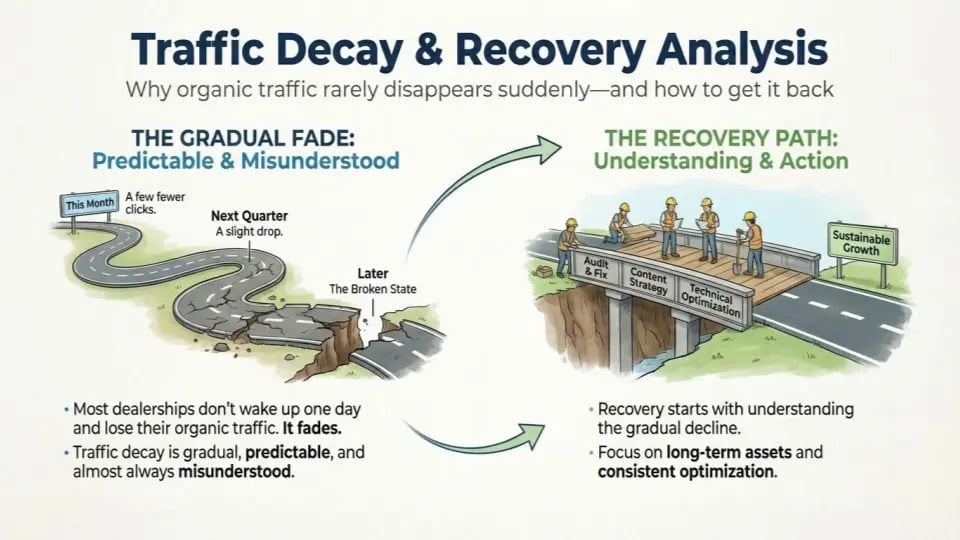
Why organic traffic rarely disappears suddenly and how to get it back
Most dealerships don’t wake up one day and lose their organic traffic.
It fades.
A few fewer clicks this month.
A slight drop next quarter.
Then, suddenly, performance feels broken.
Traffic decay is gradual, predictable, and almost always misunderstood.
What Traffic Decay Actually Is
Traffic decay isn’t a penalty.
It’s not punishment.
It’s what happens when:
- Content stops expanding
- Pages stop being updated
- Links stop accumulating
- Performance degrades
- Competitors keep building
Search engines don’t remove traffic. They reallocate it.
Decay is usually the result of inaction.
Why Dealers Miss the Early Signs
Traffic decay rarely shows up as a crash.
It shows up as:
- Flattening impressions
- Declining click-through rates
- Fewer long-tail queries
- Slower new keyword discovery
Because the decline is subtle, it’s often ignored until recovery becomes expensive.
The Difference Between Normal Fluctuation and Real Decay
Not all traffic movement is decay.
Normal fluctuation:
- Seasonal shifts
- Inventory changes
- Market demand changes
Real decay:
- Consistent downward trend
- Loss of keyword diversity
- Reduced page-level visibility
- Shrinking organic entry points
Understanding the difference prevents overreaction and misdiagnosis.
Why Most Recovery Attempts Fail
Most recovery efforts focus on symptoms:
- Rewriting titles
- Tweaking metadata
- Publishing random new content
These actions rarely address the root cause.
Traffic decays because systems stop reinforcing themselves. Recovery requires restoring momentum, not cosmetic changes.
How Traffic Is Actually Recovered
Effective recovery focuses on:
- Strengthening existing assets
- Expanding high-performing pages
- Rebuilding internal linking
- Improving speed and crawlability
- Re-establishing relevance
Recovery is about repair and reinforcement, not reinvention.
Recovery Takes Time But Less Than Starting Over
Recovering decayed traffic is slower than maintenance but faster than rebuilding from scratch.
Dealerships that understand their decay patterns:
- Recover earlier
- Spend less
- Avoid panic decisions
- Protect long-term growth
The earlier decay is identified, the easier recovery becomes.
How the Trifecta Platform Solves Traffic Decay & Recovery for Dealerships
The Trifecta platform reduces traffic decay by distributing organic visibility across multiple owned assets instead of relying on a single site. When one asset slows, others continue generating demand, preserving momentum. Recovery is faster because content, marketplaces, and AI-indexable properties reinforce each other, allowing traffic to stabilize while individual components are strengthened. This layered approach prevents small declines from turning into systemic failure.
The Bottom Line
Traffic decay isn’t mysterious.
It isn’t sudden.
And it isn’t inevitable.
It’s the predictable outcome of neglect.
Dealerships that monitor, reinforce, and expand their organic systems don’t just recover traffic they prevent decay altogether.
✍️ Signed & Accountable
This article reflects firsthand system design, live dealer data, and operational experience building organic traffic, marketplace demand, and AI-indexed content at scale for automotive dealers.