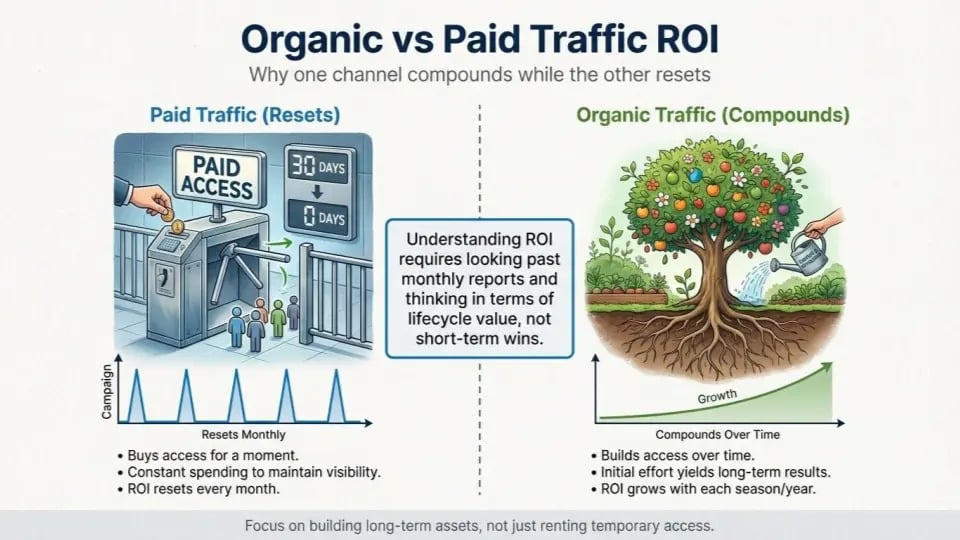
Why one channel compounds while the other resets
Every dealership spends money to get traffic.
The difference isn’t whether you pay.
The difference is what you’re paying for.
Paid traffic buys access for a moment.
Organic traffic builds access over time.
Understanding ROI between the two requires looking past monthly reports and thinking in terms of lifecycle value, not short-term wins.
Paid Traffic ROI: Immediate and Finite
Paid traffic is straightforward:
- You spend money
- You get clicks
- The moment spending stops, traffic stops
That doesn’t make paid traffic bad. It makes it predictable.
Paid traffic works best when:
- Inventory needs immediate exposure
- Promotions are time-sensitive
- Demand needs to be jump-started
But from an ROI perspective, every paid click has a ceiling. Costs rise, competition increases, and efficiency plateaus.
Organic Traffic ROI: Slow and Compounding
Organic traffic works differently.
You invest time and effort up front:
- Building content
- Improving structure
- Strengthening authority
At first, returns feel modest.
Over time:
- Cost per click drops
- Traffic stabilizes
- Conversion rates improve
- Value accumulates
Organic traffic ROI isn’t linear. It’s cumulative.
The Hidden Cost of Paid Traffic Dependency
The real risk of paid traffic isn’t cost it’s reliance.
When a dealership depends on paid media for baseline traffic:
- Budgets can’t shrink
- Margins tighten
- Decision-making becomes reactive
Organic traffic acts as a stabilizer. It reduces pressure on paid channels by ensuring traffic doesn’t disappear when spend changes.
Why Monthly ROI Comparisons Are Misleading
Comparing organic and paid ROI month to month misses the point.
Paid traffic answers:
“What did we get this month?”
Organic traffic answers:
“What did we build that still works next year?”
A fair comparison looks at:
- Lifetime traffic value
- Long-term cost per lead
- Durability of results
- Predictability over time
This is why dealerships that invest in organic traffic rarely abandon it once it matures.
Organic and Paid Work Best Together But Not Equally
The goal isn’t to replace paid traffic.
It’s to rebalance.
Dealerships with strong organic traffic:
- Use paid media more selectively
- Avoid panic spending
- Can weather market shifts
- Make smarter budget decisions
Organic traffic gives paid traffic breathing room.
Why Organic ROI Often Takes Longer Than Expected
Organic traffic ROI feels slow when:
- Content is thin
- Structure is weak
- Authority is fragmented
- Efforts are inconsistent
When organic systems are built correctly, ROI doesn’t just appear it persists.
Patience is rewarded when infrastructure is sound.
How the Trifecta Platform Solves Organic vs Paid Traffic ROI for Dealerships
The Trifecta platform improves organic ROI by turning traffic generation into an owned system rather than a recurring expense. By using marketplaces to capture demand, structured content to qualify intent, and AI-ready assets to maintain visibility, the platform allows organic traffic to grow alongside paid efforts without replacing them. Over time, this reduces dependency on paid channels and lowers the effective cost per sale, creating a more balanced and predictable ROI model.
The Bottom Line
Paid traffic is a tool.
Organic traffic is an investment.
One resets.
The other compounds.
Dealerships that understand the difference stop chasing monthly performance and start building long-term leverage.
✍️ Signed & Accountable
This article reflects firsthand system design, live dealer data, and operational experience building organic traffic, marketplace demand, and AI-indexed content at scale for automotive dealers.